

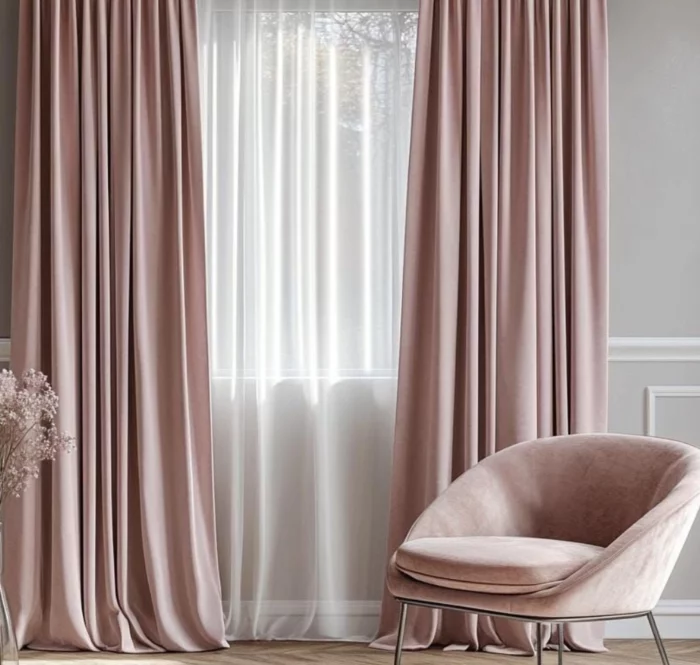
The honest answer for most Dubai rooms is: both. Sheer and blackout curtains solve different problems, and Dubai apartments typically have both problems simultaneously. Here's a clear guide to when each is right and how to combine them effectively.
What Each Type Does
Sheer Curtains
- Transmit light while diffusing it — bright but soft
- Appear opaque from outside during daylight
- Provide daytime privacy without blocking light
- UV filtering varies by fabric density (20–70%)
- Translucent from inside — you can see out
Blackout Curtains
- Block 100% of light when correctly installed
- Opaque from both inside and outside
- Provide total visual privacy day and night
- Significantly reduce solar heat gain
- Available in any outer fabric (linen, velvet, printed)
The Dubai-Specific Problem
Most international guides frame sheer vs blackout as an either/or choice. In Dubai, the combination of factors means you often need both functions from the same window:
- Privacy: High-density developments mean apartments often face directly into other buildings. A bare window in the daytime is visible to neighbours.
- Light quality: Dubai's intense light creates harsh glare — sheer curtains soften this to usable ambient light.
- Darkness at night: City lights, streetlighting, and the Burj Khalifa illuminations mean bedrooms can be genuinely bright at night without blackout curtains.
- Early sunrise: The 5:28am June sunrise makes bedroom blackout genuinely important for sleep quality.
The Solution: Double-Track Systems
The standard solution for most Dubai living rooms and bedrooms is a double-track curtain system — sheer curtain on the inner track, blackout or linen curtain on the outer track. Each layer is operated independently.
How It Works in Practice
- Morning: Blackout curtains open (pushed to the sides). Sheer curtains remain closed. Natural light enters — diffused, no glare, privacy maintained.
- Afternoon (hot/sunny): Both layers closed. Maximum light and heat reduction.
- Evening: Blackout curtains closed. Sheer curtains remain closed or open if privacy isn't a concern (high floor, no facing building).
- Night: Blackout fully closed. Zero external light entry.
Room-by-Room Recommendation
| Room | Recommended | Reason |
|---|---|---|
| Master bedroom | Blackout only, or double-track | Early sunrise; night privacy essential |
| Children's bedroom | Blackout (essential) | Children most sensitive to early light |
| Living room | Double-track (sheer + linen/velvet) | Need both daytime diffusion and evening privacy |
| Dining room | Sheer or linen (no blackout) | Used in evenings; light control less critical |
| Study / home office | Sheer or UV-rated linen | Glare control; blackout counterproductive |
| Media room | Full blackout specification | Darkness required for screen performance |
Night-Time Transparency: The Common Sheer Concern
The question we hear most often about sheer curtains: "Can people see in at night?" The answer: yes, sheers invert at night. During the day, the brighter outdoor light makes sheers appear opaque from outside — you can see out but they can't see in. At night, with interior lights on, the equation reverses: you can be visible through sheer curtains from outside.
For living rooms on floors above the 10th floor, this is rarely a practical concern. For lower-floor apartments in facing buildings, the solution is either to close the blackout layer for privacy in the evening, or to choose a denser sheer fabric with higher privacy rating. We discuss the right specification for each window orientation at the home visit. Full sheer curtains guide →
Can Blackout Curtains Let Light Around the Edges?
Yes — and this is one of the most common disappointments with budget blackout curtains. Even a genuine blackout fabric allows light into the room if it's not correctly installed. The two sources of edge light are the sides (gap between curtain and wall) and the top (gap between curtain heading and ceiling).
Both are solved by installation method, not fabric choice. Returnable tracks (where the curtain wraps back to touch the wall on each side) and pelmets (fabric-covered boxes above the window) eliminate both sources of edge light. We specify these as standard for bedroom blackout installations. Full blackout guide →
The Simple Rule
Bedrooms: blackout, always. Living rooms: sheer for the day, linen or velvet for the evening — on a double track. Everything else depends on your floor level, window orientation, and how you use the room. The home visit is where we work this out for each window specifically.